4/28/10

Training in Conffined Spaces

^ deployment or extended training exercises you may encounter conditions that limit your physical training routines and options. Submarines and small assault craft probably create the greatest challenge; but a well balanced training program can be maintained even with limited space and equipment. So, take this opportunity to design new routines with alternative exercises and have fun. The concepts for designing training routines in confined spaces is the same as any gym-based routine, you just have to be more creative. Follow the FITT Principle guidelines outlined in Chapters 4, 5, and 7 and try some of the exercise in this chapter when designing your workouts.

clip_image002

Aerobic Conditioning

clip_image002[4]

clip_image003Performing your aerobic training routines may seem impossible if you don't have access to cardiovascular training equipment or large areas to train. However, with a little creativity you can design a training routine to maintain your fitness level. Some exercises you can perform in confined quarters with minimal equipment include:

♦ Jogging or marching in place.

♦ Jumping rope or jumping jacks.

♦ Stair stepping, if you have access to stairs or if you have space for
an aerobic step bench (plastic step with risers).

Strength Training

clip_image004In addition to calisthenics, strength exercises using light-weight, portable equipment, such as elastic tubing, dumbbells or a ball, can be performed in small spaces. Examples of these exercises are shown in Table 10-1. Regardless of the equipment used, the general principles and techniques outlined in Chapter 7 for muscle strength and endurance training apply. Follow the set and rep recommendations outlined in Chapter 8 for calisthenic exercises, starting with one set of eight reps. Include exercises for each of the major muscle groups mentioned in Chapter 7, Figure 7-2.

Elastic Tubing and Bands

с

a. 4 ft. elastic band.

b. 1 ft. elastic loop
with foam handles.

с Nylon anchor piece to place in door jams.

clip_image006These come in different widths and resistances, each designated by a different color. (As a rule, the smaller the tube's width, the less resistance it provides.) The basis of elastic tubing exercises is that as you stretch the

tubing during your exercise, it provides a continuously increasing resistance. Resistance can be adjusted by: 1) altering the placement of the tubing (addressed in Table 10-1), 2) using two tubes, 3) using a thicker tube, or a combination of all these. Note that using two thin tubes may provide less resistance than using one thick tube. Typically, tubes and bands are sold in


4 ft. lengths and cost $5 to $10. When purchasing tubing, buy one with handles large enough to slip over your forearms. Buy several tubes of varying widths since you will need different resistances for different exercises. Also, check the tubes periodically for wear and tear

Flexibility Exercises

One of the most safest and most beneficial types of flexibility exercises is static stretching. Static Stretches are slow, controlled movements through a full range of motion. The term "static" means the stretch is held at the end of the joint's range of motion. These static exercises are considered safe and effective because they stretch the muscles and connective tissue without using fast movements that will be resisted by the muscles. These exercises can be done actively (e.g., you contract the opposing muscle group to stretch the target muscle group) or passively (e.g., you use a towel to stretch the muscle). Incorporate the static stretches in Table 9-1 in your exercise program. These exercises target the muscle groups shown in Chapter 7, Figure 7-2. Select at least one stretch for each muscle group. Hold each stretch for 10-30 seconds then rest 10 seconds. Repeat each stretch 2-5 times. Muscle balance also applies to stretching, so stretch opposing muscle groups (e.g., stretch hamstrings and quadriceps).

A second type of flexibility exercises is dynamic stretching (Table 9-2). Dynamic Stretches are controlled muscle contractions through a joint's range of motion. These stretches should be used to enhance the performance of an activity that immediately follows the stretch; i.e., swinging your racket prior to a tennis match. This type of stretching warms the muscles. Dynamic exercises are safe as long as you do not use momentum to force a joint through a greater range of motion than it is capable. Also, avoid bouncing movements. (See page 73.)

Table 9-1. Static Stretches


Calf Stretch

clip_image005

Standing on a step, place the ball of the right foot on the edge of the step. Bend left knee and gently drop right heel. Stretches the right gastrocnemius. Variation: To stretch the ankle, slightly bend the right knee after dropping your right heel. Switch legs and repeat.

Quadriceps Stretch

Lie on stomach with both legs extended. Slowly bend left knee. Gently grasp left ankle with right hand and pull toward body. Keep back straight. Stretches the quadriceps. Switch legs and repeat. Variation: Perform stretch when standing, holding on to a stationary object to keep your balance.

clip_image007

Hamstring Stretch

clip_image009

Lie on back with both legs extended. Bring left leg to

chest and grasp left thigh with both hands. Gently pull left leg toward chest. Stretches left hamstring and right hip flexor. Switch legs and repeat.

Modified Hurdler's Stretch

clip_image011

Sit down, extend right leg and place left foot against inner right thigh.

Gently bend forward from the hips, toward toes. Stretches the hamstring. Switch legs and repeat.


Table 9-1. Static Stretches


Hip Stretch

clip_image013

Lie on back with knees bent, feet flat on the deck. Place right ankle on left knee. Grasp left thigh with both hands and gently pull it toward chest. Switch legs and repeat. Stretches hip extensors.

Pretzel Stretch

clip_image015

Sit with both legs straight. Bend the left knee and cross left foot over the right shin. Turn torso left and place right elbow just below the left knee. Turn as far left as possible. Stretches hip abductors, lower back, and iliotibial band. Switch legs and repeat.

Butterflies

clip_image017

Sit with legs bent and bottoms of feet together. Wrap hands around ankles and gently lean your torso

forward, keeping your back flat.

Do not pull on ankles or press

knees down with elbows.

Stretches hip adductors.

Lunge

clip_image019

With feet side by side, take a large step forward with left foot. Bend your left knee until it is

directly over left ankle. Gently press your hips forward and down, keeping your back straight. Stretches hip flexors. Switch legs and repeat.


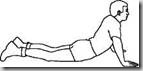
Lizard

Lie face down, palms on the deck under your shoulders. Gently lift torso with arms and lower back muscles. Lift only until your pelvis is off the deck. Stretches the abdominals.
clip_image021

Lower Back Stretch

clip_image023

Lie on back, bring knees to chest and grasp knees with hands (arms may either be below

or above lower legs). Gently pull both knees toward chest. Lift chin toward chest. Stretches the lower back.

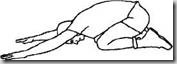
Kneeling Back Stretch

Kneel down with knees shoulder width apart. Sit back on your heels. Lean forward so your chest rests on your thighs. Extend arms over head. Stretch arms and chest as far forward as possible. Stretches lower back.
clip_image025

Upper Back Stretch

clip_image027

Clasp hands together in front of chest, palms facing out, arms extended. Press through palms until back and shoulders are rounded. Stretches back and shoulders. Can do seated or standing.

Posterior Shoulder Stretch

clip_image034

Bring left arm across chest. Use right hand to gently push upper left arm toward chest. Stretches shoulders. Switch arms and repeat.

Triceps Stretch

clip_image036

Bring left arm up and back until left palm is between shoulder blades and left elbow is above left ear. Gently grasp upper left arm with right hand and push left arm behind head. Stretches the triceps. Switch arms and repeat.

Chest Stretch

Clasp hands behind lower back, thumbs pointed down. Gently pull arms up toward ceiling. Stretches chest and shoulders. Can do seated or standing.

clip_image038

Neck Stretch

clip_image040

Clasp hands behind back. Bend neck so right ear moves to right shoulder. Gently pull left arm. Stretches neck. Switch arms to stretch the right side of the neck.

Table 9-2. Dynamic Stretches

clip_image044

Neck Stretch

Begin from a standing position. Count 1: slowly roll the head to one side, Count 2: slowly roll the head to the front, Count 3: slowly roll the head to the other side, Count 4: slowly roll the head to the front again. Repeat. Do not roll the head back. Stretches the neck muscles. Variation: Turn your head to look over your right shoulder then slowly turn your head to look over your left shoulder. Repeat.

Up Back and Over

Begin from standing position with arms at sides. Count 1: slowly bring both arms forward and upward. Count 2: slowly bring both arms down and back. Count 3: slowly move both arms forward, up, back, and around to complete a full circle. Stretches the shoulders, chest, and back.

Press-Press-Fling
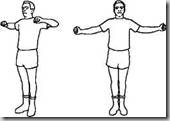
clip_image046Begin from a

standing

position with

arms bent,

fists at chest

level, and

elbows out to

the side. Count

1: gently pull

elbows back

and release. Count 2: repeat count 1. Count 3:

slowly extend arms and pull them back.

Stretches the chest and shoulders.

clip_image047

clip_image049

clip_image051

X

Trunk Twisters

Begin in a seated

clip_image053

position with legs

crossed and hands

placed behind your

head. Count 1: slowly

turn your torso, at the

waist, to the right and

pause. Count 2: slowly

turn your torso to the

left and pause. Repeat. Stretches abdominals

and obliques.

Standing Toe Pointers

Start from a standing position with body weight over the heels. Flex and extend the feet and toes. Stretches both the calf muscles and the muscles in front of the shins. Variation: walk on the heels with toes pointed upward.

Four-Way Lunges

Begin from a standing position. Count 1: lunge forward with right leg, distributing body weight across both legs. When lunging forward, the knee should not extend beyond the toe of that leg. Count 2: using the right leg, push off and return to start position. Repeat this movement using the same leg but lunge to the side. Perform exercise with the left leg. Stretches the leg muscles.

clip_image054Table 9-1 and Table 9-2 were adapted from The Navy SEAL Physical Fitness Guide.

Physiology of Stretching

clip_image001To understand the proper techniques for stretching it is helpful to know how the muscle and connective tissue respond to being stretched. There are areas within both your muscles and tendons that can sense both how quickly and how far your muscles and tendons are being stretched. These areas protect your muscles and tendons from becoming overstretched or torn during a quick stretch by causing a reflex muscle contraction. This muscle reaction is called the stretch reflex. A classic example of this is when someone taps your leg just below the kneecap. This action quickly stretches the quadriceps muscle (see Figure 7-2) and causes your thigh to contract and kick out your lower leg. The quicker the stretch, the stronger the reflex contraction. Therefore, by stretching slowly you avoid contracting the muscle you are trying to stretch!

Tendons respond to stretching as well. They cause the stretched muscle attached to the tendon to relax and signal its opposing muscle to contract. This protects the stretched muscle and tendon from tearing. As a stretch is held your muscles and tendons adapt to the new length.

The most effective stretches are performed slowly and are held for 10 - 30 seconds.

Flexibility

Most trainers, exercise physiologists, and health care professionals agree that flexibility training, although often overlooked, is an important component of a physical fitness program. Stretching becomes even more important as you achieve advanced levels of muscle strength and endurance. If optimum functional fitness and military readiness are the goals, then well-balanced flexibility training is a must.

Benefits of Stretching

clip_image002

What is flexibility? When someone says they are flexible, what do you think of? Maybe you picture someone who can touch their toes. Flexibility is the ability to move your joints freely through a full range of motion. The range of motion at each joint is different and depends largely upon the structure of the joint and the condition of the muscles, tendons, and ligaments around the joint. Proper stretching increases flexibility and leads to:

♦ Reduced muscle soreness after exercise.

♦ Lower risk for injury.

♦ Mental and physical preparation for
exercise or competition.

♦ Enhanced muscle performance through a
larger, functional range of motion.

♦ Mental relaxation.

The goal of flexibility training should be to enhance joint movement while maintaining joint stability. Therefore, stretching exercises complement both strength and aerobic activities. An intense workout can cause small tears in muscles. Also, during exercise recovery, muscles and connective tissues (ligaments and tendons; defined in the Glossary) can shorten. Stretching prevents this muscle shortening and decreases the muscle soreness associated with intense workouts.

clip_image002[7]

Abdominal Exercises

Abdominal muscles help support the lower back. Therefore, strong abdominal muscles can decrease the risk of developing lower back pain. When doing abdominal exercises on the deck, only a portion of the abdominal's range of motion is being strengthened because your lower back is flattened. However, by placing a rolled towel under your lower back you can extend the range of motion for abdominal exercises (see Figure 8-1).

Figure 8-1. Range of Motion of the Abdominals

clip_image004

Flexion (75-90°)

Extension (30°)

clip_image006X

Neutral (0°)

A rolled towel under the

lower back increases trunk

extension when performing

abdominal exercises.

Towel

In this section two common abdominal exercises, the curl-up and the crunch, will be described. The curl-up, used on the PRT as a measure of muscle endurance, targets both the abdominal and hip flexor muscles. The form for the curl-up is:

clip_image008

From OPNAVIST 6110.1E

♦ Lie on back with knees bent, feet flat on
deck, heels 10 inches from buttocks and held
down by a partner. Cross arms and hands on
chest or shoulders.

♦ Curl torso up, touching elbows to upper
thighs while hands remain on the chest or
shoulders. Exhale as you lift.

♦ Lie back until the lower edge of your
shoulder blades touches the deck. Inhale as
you lower.

The crunch is similar to the curl-up but is performed within a smaller range of motion. The torso is lifted by abdominal muscles during a crunch. The form for the crunch is:

clip_image010

♦ Lie on back with knees bent 90°, feet flat on
deck, shoulder width apart. Do not anchor
your feet. (Anchoring your feet or placing
your legs out straight on the deck will target
your hip flexors, not your abdominals.)

♦ Place fingertips lightly on the back of the
head, elbows out to sides and in line with

ears. (Variations to this include arms at sides, arms across chest, and arms above head.)

♦ Lift torso until the shoulder blades come off the deck by moving
rib cage toward hips. Exhale as you lift. Look up at the ceiling to
prevent neck strain.

♦ Return to the starting position. Inhale as you lower.

Some people may develop lower back pain if they perform curl-ups routinely. For them, the crunch is recommended as an alternate exercise. Regardless of which exercise you choose when training, focus on the quality, not the quantity, of repetitions. If you perform either exercise rapidly, you are using momentum and not building abdominal strength!

Muscle Balance

As discussed in Chapter 7, muscle balance is an important consideration when designing any strength workouts. Exercises should be selected according to which muscle groups they target (Table 7-2). Table 8-1 lists several calisthenic exercises and the muscle groups they target. Use this table to design your calisthenic routine. Also, you can add any of these exercises to your gym-based strength and endurance routines to create variety and alleviate boredom.

Calisthenic Guidelines

When performing calisthenics to develop muscle strength or endurance, you should follow the same recommendations outlined in Chapter 7. Intensity is largely based on the number of sets and reps, and the length of rest periods. Resistance is provided by body weight rather than an external resistance. Proper form for calisthenic exercises follows many of the general exercise guidelines outlined in Chapter 7. Detailed instructions are found in Table 8-1. (Table 8-1 was adapted from The Navy SEAL Physical Fitness Guide.)

To begin a calisthenics program select one exercise per muscle group from Table 8-1. Perform this routine two to three times per week.

♦ For each exercise, start with one set of eight reps. Each set
should take about one minute. Rest for 60 seconds after each set.

♦ Gradually increase your workout by adding one or two reps per
week until you can perform twelve reps with good form.

♦ Once you have reached this point, do two sets of eight reps of
each exercise. Again, increase your workout by one or two reps
per set each week until you can perform two sets of twelve reps.

♦ Once you have reached this point, do three sets of eight reps;
again, gradually increase your workout by one or two reps per set
each week until you can do three sets of twelve reps.

♦ At this point you can increase the difficulty of your workout by:
1) changing the exercises you perform; 2) increasing the number
of reps per set; 3) modifying the difficulty of the exercise; 4)
decreasing your rest period; or 5) for each muscle group, do a
different exercise during each one of your sets (for example, do
one set of one-legged squats and one set of hand-to-knee squats as
your two sets of leg exercises).

Once you can perform three sets of 12 reps, try some of the modifications listed below or in Table 8-1 to increase the difficulty of the exercises. These modifications can be useful for developing and maintaining muscle strength when training equipment is not available.

♦ Gradually add weight (e.g., do pull-ups or push-ups with a
weighted pack).

♦ Use a partner for resistance (e.g., have a partner push against
your lower leg during leg extensions).

♦ Exercise one side of the body first (i.e., one-legged squats), then
repeat the exercises for the other side.

♦ Modify the exercise (e.g., elevate legs during crunches).

♦ Perform super sets or pyramids (see Chapter 7).


clip_image001[6]Table 8-1. Calisthenic Exercises Arranged by Muscle Group

clip_image003

clip_image005

clip_image007

DC Ш

a

_i

D О

Ш

X

о

Push-Ups

Lie on stomach, feet and hands shoulder width apart on deck, head facing forward, body straight. Extend arms. Count 1: Bend elbows 90°, lowering chest toward deck. Count 2: Return to start position. Works triceps, chest, shoulder, and abdominals. Variations: Fingertip Push-ups - Begin as above, except use fingertips to support weight. Works forearms and improves grip strength. Triceps Push-ups - Begin as above, except place your hands close together beneath your chest and spread fingers apart. Your thumbs and index fingers of both hands should almost touch.

Dips

Rest hands on parallel bars. Extend arms; legs are not to support your weight unless needed for assistance. Count 1: Bend the elbows until shoulders are level with the elbows. Count 2: Extend arms to return to start position. Works triceps, chest and shoulders.

О

<

m

clip_image009

Pull-Ups

Begin from a dead hang on a horizontal bar, arms shoulder-width apart, palms facing out. Count 1: Pull body up until chin touches bar. Do not kick. Count 2: Return to start position. Works the back and forearms. Grip variations: Narrow, Wide.

clip_image011

Incline Pull-Ups

Using a low bar, lie or sit on the deck

with chest under bar, place hands

shoulder-width apart on bar, palms out.

Count 1: Pull upper body toward bar at

a 45° angle. Squeeze shoulder blades

together during movement. Count 2: Extend arms. Works

back, shoulders, and arms.

clip_image013

Chin-Ups

Begin from a dead hang (i.e., full extension) on a horizontal bar, arms shoulder-width apart, palms facing in. Count 1: Pull body upward until chin touches top of bar. Do not kick. Count 2: Return to start position. Works the back, biceps.

Neck Rotations

Lie on back. Count 1: Lift head up and over to side. Count 2: Bring head to center; Count 3: Bring head to other side. Count 4: Return head to start position. Works neck flexors.

clip_image016

Straight Leg Raise

Sit on the edge of a bench, keeping

back straight. Place hands behind you

for support. Bend left knee 90°.

Straighten right leg in front of you with

your right heel resting on the deck.

Count 1: Slowly raise your right leg,

lifting it no higher than your hips,

Equipment

Strength training requires minimal personal gear: weights, a pair of supportive shoes, fitted lifting gloves, and standard PT attire. A weight lifting belt is only recommended during maximal or near maximal lifts, and is not recommended at all for exercises that do not stress the back. This is because the belt takes over the role of the abdominal muscles in stabilizing the torso, preventing the strengthening of the abdominal muscles which can increase the risk for injury when lifting a heavy object without the belt.

The most common barbells found in gyms are Olympic style barbells. These barbells have a narrow center bar for gripping and wider ends for loading weights. They are 5 to 7 ft. long and weigh 30 to 45 pounds (lbs) or 13 to 20 kilograms (kg). The plates used to load the bars are available in both lbs and kg, and range between 2.5 to 45 lbs or 1.25 to 20 kg. Make sure you pay attention to the weight measurements in your gym; there is a big difference between 10 lbs and 10 kg! Lastly, you are encouraged to use adjustable collars to keep the plates on the bar. Depending on the style of collar, the pair can add 1 to 5 lbs to your bar. There are several other styles of barbells which range in size and weight. Ask a staff member at your gym to help you determine which barbell would best suit your needs.

Choosing free weights, machines, or a combination of both depends largely on your goals and training experience. Table 7-2 lists a comparison of free weights and machines to help you with your choice. If you are new to a fitness center or if you are unsure how to work a piece of equipment, ask a fitness center staffer for an orientation. This orientation will help you design a workout routine based on the equipment selection at your fitness center.

Though this chapter focuses on resistance machines and free weights, resistance for strength training can come from a variety of sources, including your own body weight. To learn about other exercise techniques and equipment available for strength training see Chapters 8 and 10. These other options may be most beneficial when space and equipment are limited.

Types of Workouts

clip_image002[4]Following is a description of several strength training routines. Choose the routine that is best for you based on the time available, your goals, your training experience, and your fitness level.

Full body workouts - All the major muscle groups (as listed in
Worksheet B-2) are exercised during a single session. Perform
one to two sets of an exercise for each muscle group and rest
between sets. This should take 20-45 minutes. For general
strength training purposes; should be done at least twice a week.

Circuit Training - Combines aerobic and strength exercise
stations. Each exercise station takes 30-45 seconds to perform
and stations alternate between upper and lower body exercises.
The circuit is repeated two or more times per session. It improves
aerobic conditioning and moderately increases strength when
performed three times per week. This routine is good for people
who have less than 45 minutes to do both aerobic and strength
exercises. (See Table 10-2 for an example.)

The following routines are more advanced workouts. They should only be performed once you have developed a solid strength base using one of the above formats, and you have exercised regularly for at least eight weeks, and are comfortable with the correct lifting techniques.

Split-routine workouts - Different muscle groups are targeted
on alternate training days. Examples include: upper versus lower
body, or push (e.g., chest press, leg extension) versus pull (e.g.,
seated row, leg curl) exercises. Allows for more intense training
for each muscle group per training session; is time consuming.

Pyramid sets - Successive sets of the same exercise are
performed with progressively greater resistance while decreasing
the number of reps. For example: perform 10 reps with a 10-rep
weight in set 1; perform eight reps with an eight-rep weight in
set 2; perform six reps with a six-rep weight in set 3. Rest
between sets. You can mix up the number of sets and reps per set
that are performed. Allows for a varied training intensity, but is
more time consuming than performing one set per exercise per
muscle group.

Super sets - Performing two exercises for opposing muscle
groups without a rest period between sets. Example: a set of a
chest exercise immediately followed by a set of a back exercise,
followed by a rest. This combination can be repeated one to two
more times. Limit this type of workout to once a week; on the
remaining workout days, rest between each set. May be useful for
muscle hypertrophy.

Compound sets - Performing two exercises for the same muscle
group without a rest period between sets. Example: a set of one
chest exercise immediately followed by a set of a different chest
exercise, followed by a rest. Repeat this combination one to two
more times. Limit this type of workout to once a week; on the
remaining workout days, rest between each set. May be useful for
muscle hypertrophy.

Use the guidelines provided to develop sound strength training programs and alternate exercises with in each muscle group every four to eight weeks to maximize strength gains, enhance job-related fitness, and have fun!


Calisthenics


require minimal equipment and can be performed in almost any location. These exercises can be used to develop and maintain muscle strength and muscle endurance, and can be particularly useful when strength training equipment is not available.